The problem classes#
Each tile on Home is a problem class: a geometry the window sets up with its own sheet, computes its own numbers for, and reads with its own pages. A class starts from one of solprop’s example recipes, and Start from on its sheet offers a few more chosen for it; solprop’s other examples belong to the gallery’s scripts. Whatever a class does not show on its sheet is under Advanced, so no keyword of the route is out of reach.
Every class shares the stages, the z slider and the plot tools; what differs is listed here. The pages themselves are described in Reading the results.
Gas-filled hollow guides#
Capillary is a gas-filled hollow capillary,
mode-averaged or with several modes (the Modes row; a multimode run adds the Modes page). Its numbers come from
solprop.tools.capillary_params(): the soliton order, the zero-dispersion
wavelength and the dispersive wave, each of which can be set as a target, and the peak
power and intensity, the fission length and the loss at the pump. Its preview is the
group-velocity dispersion at the entrance. Its pages are Overview, At this plane,
Spectrogram, Along z, Modes, Compress and Run health.
Antiresonant fibre is a gas-filled hollow fibre with a lattice of tubes, set by their number, radius and wall thickness. Its numbers are the capillary’s, from the fibre’s own mode, and only the soliton order can be set as a target. Below the dispersion it draws the loss against wavelength and the fibre’s cross-section to scale. Its pages are the capillary’s.
The gas row offers solprop’s gases by name, and the pressure can be a single value or a profile along the guide (from … to): gas profiles.
Free-space beams#
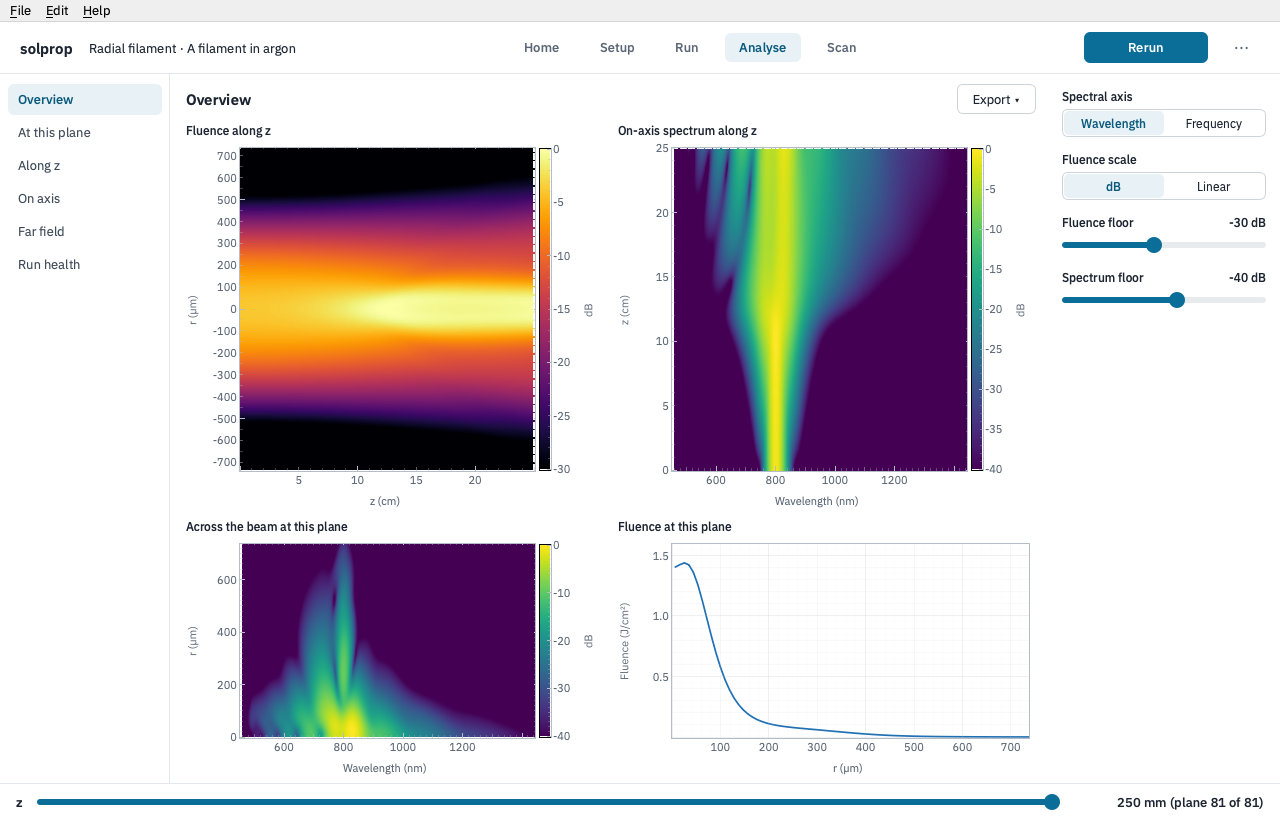
Radial filament is a beam in free space on a radial grid: self-focusing, plasma and filamentation in a gas. The beam is given by its waist and the distance to focus; From a lens… sets both from a lens’s focal length and the beam on it. Its numbers are P / P_cr with the critical power, the peak power, the Rayleigh range and Marburger’s collapse distance. Its preview is the beam’s linear radius along z, with the focus and the collapse marked. Its pages are an Overview of the fluence along z (mirrored about the axis), the on-axis spectrum along z, the radius against wavelength at the plane and the fluence across it; At this plane (the beam in r and time, and in r and wavelength); Along z; On axis (the pulse, its spectrum and its spectrogram on the beam’s axis); Far field (angle against wavelength, where conical emission shows); and Run health.
Cartesian beams starts from two beams crossing at 10 mrad in argon, on an x–y grid: they interfere where they overlap, and the Kerr effect focuses the fringes. Each beam has its own energy, waist, offset and angle in x, and they share a wavelength and duration; the numbers (P / P_cr, critical power, peak power and Rayleigh range) are each beam’s. Across the beam maps the fluence over x and y at the plane. A recipe or file of one beam on such a grid opens on a one-beam sheet with the filament’s numbers.
Line beam is a beam resolved in x alone, per metre of y: its energy and peak power are per metre, and Across the beam maps the fluence across x along z. It has no collapse distance, so it shows no P / P_cr.
Free-space results files can be large, so the sheet’s Ready line gives the output’s size before a run. Compression is not offered for free-space runs.
Solid-core fibres#
GNLSE fibre is a fibre given by its nonlinear coefficient γ and the Taylor coefficients of its dispersion alone, in the generalised nonlinear Schrödinger equation (the GNLSE). Its numbers are the soliton order, the zero-dispersion wavelength, the energy, the dispersion, nonlinear and fission lengths, and its preview the group-velocity dispersion. Its Raman row is solprop’s GNLSE default, the response of fused silica.
Step-index fibre is a solid core in a cladding of lower index (step-index fibres), its guided mode solved by solprop for the GNLSE: the mode gives the dispersion, the loss and the effective area, and γ comes from the mode and the nonlinear index n₂. An empty core row is fused silica and an empty cladding row is air, index 1. It shows the mode’s dispersion and the fibre’s cross-section.
Graded-index fibre is a core whose index falls from its axis, with several of its modes coupled (graded-index fibres). It is read from its index profile without solving it: its numerical aperture, its V number and roughly how many modes a power-law core of that exponent holds, with the index across the core as its preview. Its Modes page shows each mode’s spectrum, and gives no energy per mode: these modes are not orthogonal, so their energies do not add, and the run records only their total (on Along z).
Other routes#
solprop has routes with no class in the window: the hollow rectangular guide, planar
guides and general modes among them. They are set up in scripts. A recipe or a results
file of such a route, opened from Home, still opens: on a form built from solprop’s own
description of the route (solprop.recipe.metadata.parameters()), its sections
as solprop groups the keywords, with the energy and peak power of the launched pulse,
and with the pages its results file supports. The window finds a file’s class from its
recipe, and uses this form when none fits.